ในโอกาสที่บทความวิจัยเรื่อง
“The conservation of living cultural heritage toward World Heritage inscription: a case study of Wat Phra Mahathat Woramahawihan, Thailand”
ได้รับการเผยแพร่ (Published) ในวารสาร Journal of Asian Architecture and Building Engineering
 SCOPUS Q1, percentile: 95

Abstract : This study develops and applies a pre-nomination readiness assessment framework for living cultural heritage properties, addressing a gap in World Heritage scholarship. Using Wat Phra Mahathat Woramahawihan, Nakhon Si Thammarat, Thailand, as a case study, it examines whether existing conservation and management practices sustain both tangible attributes and the cultural processes through which heritage significance is produced. The qualitative case study combines documentary analysis, field surveys, photographic documentation, spatial mapping, and research-team assessment. The framework integrates eight dimensions: living heritage, Outstanding Universal Value, authenticity, integrity, people-centred conservation, governance and management, Historic Urban Landscape, and sustainability. The nominated property achieved a mean score of 3.65, while the buffer zone scored 3.50, indicating high readiness. Key strengths include continuous religious use, ritual transmission, contextual authenticity, community participation, and interaction between the temple, sacred practices, and surrounding communities. However, weaknesses remain in buffer-zone protection, integrated governance, urban development control, tourism management, intergenerational transmission, and formal safeguarding of intangible heritage. The study extends UNESCO-oriented assessments beyond material authenticity and integrity by operationalising living heritage values before nomination. It offers a transferable decision-support framework for identifying strengths, management gaps, and intervention priorities at living religious sites in Thailand, Southeast Asia, and comparable cultural contexts elsewhere.


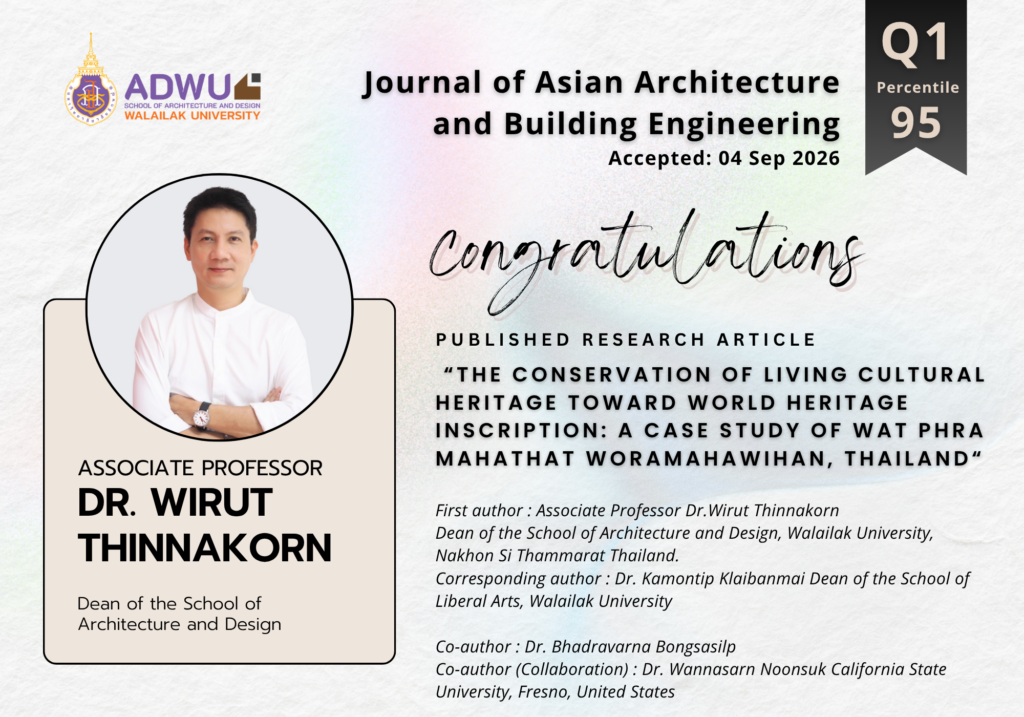

 ขอแสดงความยินดีกับ รศ.ดร.วิรุจ ถิ่นนคร
  คณบดีสำนักวิชาสถาปัตยกรรมศาสตร์และการออกแบบ มหาวิทยาลัยวลัยลักษณ์
 First Author: Associate Professor Dr. Wirut Thinnakorn
 Co-author: Dr. Wannasarn Noonsuk